
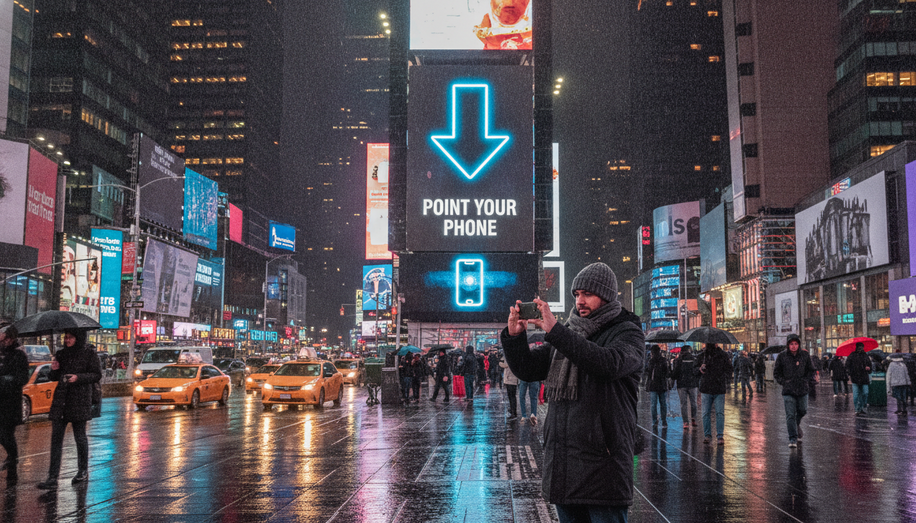

For years, the humble QR code reigned supreme as the undisputed bridge between the physical and digital worlds. Revived by the touchless demands of the early 2020s, it offered a straightforward, if occasionally clunky, way for out-of-home (OOH) advertising to drive mobile engagement. Today, however, the landscape has radically matured. While the black-and-white grid remains a reliable staple, modern OOH campaigns are increasingly pushing past the limits of optical scanning. Advertisers are realizing that asking a consumer to break their stride, open their camera, align the frame, and wait for a link to load can sometimes be a friction point too far. In response, a new generation of sophisticated, frictionless call-to-actions (CTAs) is emerging, transforming billboards and transit shelters from static viewing experiences into highly interactive, immediate conduits of consumer action.
Among the most seamless of these technologies is Near Field Communication (NFC). Already deeply integrated into consumers’ daily routines through contactless payments and transit passes, NFC is now redefining how audiences interact with street-level OOH. By embedding tiny, inexpensive NFC chips into transit shelters, mall kiosks, or interactive posters, brands can prompt action with a simple touch. Rather than struggling with poor lighting, glares, or distance issues that plague QR codes, a passerby merely taps their smartphone against the designated area of the display. Instantly, a coupon is saved to their mobile wallet, a map of the nearest retail location opens, or a video trailer begins to play. This “tap-to-interact” mechanic capitalizes on existing muscle memory, turning physical proximity into immediate, frictionless digital acquisition.
Beyond personal mobile devices, digital out-of-home (DOOH) screens themselves are transforming into active participants. Interactive digital displays equipped with computer vision, motion sensors, and even voice-recognition technology are turning passive observers into active players. Some of the most successful recent campaigns have eschewed mobile redirects entirely in favor of on-screen gamification. Pedestrians might find themselves using hand gestures to catch falling virtual items on a storefront screen, or using voice activation to reveal a hidden discount code. By shifting the call-to-action from a personal phone screen to a shared public installation, brands not only drive direct engagement but also create a spectator effect, drawing in surrounding crowds and generating viral, shareable moments that extend far beyond the physical location.
Simultaneously, the classic SMS shortcode has undergone a modern, conversational renaissance. No longer limited to a simple “text to win” prompt, contemporary SMS integrations leverage automated conversational AI to guide consumers through highly personalized funnels. When coupled with advanced geofencing, the physical billboard becomes the starting gun for a hyper-localized mobile journey. Programmatic DOOH platforms can detect when a user is in the vicinity of a specific screen, triggering contextual push notifications or inviting them to opt into an interactive texting flow that offers real-time directions to a nearby store. This elegant coordination between the macro-scale billboard and the micro-scale mobile screen ensures that the call-to-action is both highly visible and contextually relevant to the consumer’s immediate journey.
Perhaps the most sophisticated frontier of modern OOH lies in deep-linking and custom app integrations, particularly within augmented reality (AR). Instead of directing users to a generic web browser, advanced campaigns are leveraging image-recognition technology embedded within popular platforms like Snapchat, Instagram, or proprietary retail apps. When a consumer points their camera at a billboard, the image itself acts as a trigger, instantly launching an immersive AR lens that superimposes digital products onto the street around them or opens a direct-to-cart checkout page. This eliminates multiple steps in the purchasing funnel, turning a moment of visual inspiration directly into a transaction.
Ultimately, the shift away from the basic QR code reflects a deeper understanding of human behavior in physical spaces. Modern OOH is no longer just about catching the eye; it is about respecting the consumer’s time and physical context. By deploying a diverse toolkit of NFC taps, voice interactions, conversational SMS, and seamless app integrations, advertisers are building a more intuitive, playful, and frictionless bridge to the digital world. As these technologies continue to converge, the line between seeing an ad and taking action will only continue to blur, ushering in an era where every outdoor display is an open, invitation-only portal to engagement.