
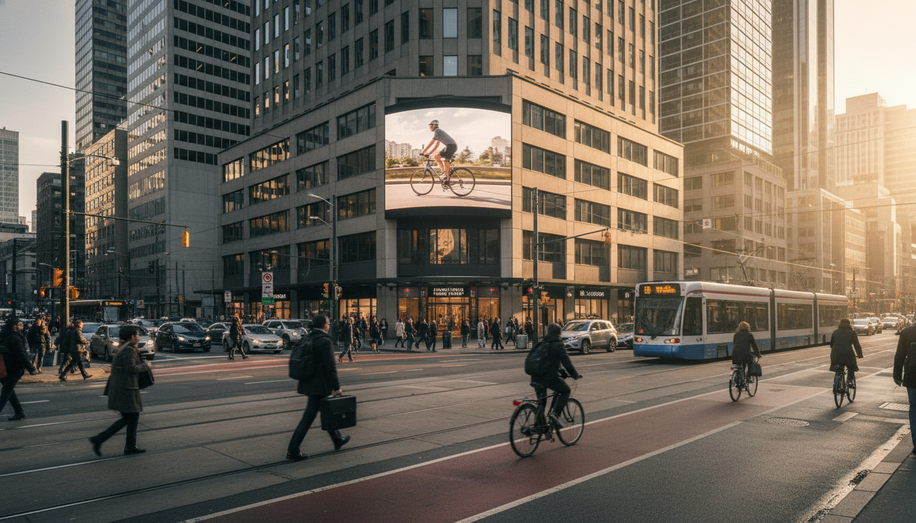

In out-of-home advertising, location has always mattered. What has changed is the precision with which advertisers can now understand it. For decades, planners relied on traffic counts, demographic overlays and instinct to determine where a billboard or digital screen might perform best. Today, advanced location intelligence is turning placement into a far more exact science, helping brands identify not just where people pass, but who they are, when they move, how often they return and whether a message is reaching them in the right context.
That shift is reshaping how OOH campaigns are bought, measured and optimized. Rather than treating a site as valuable simply because it is busy, advertisers are increasingly evaluating whether it sits along meaningful consumer paths. A commuter corridor, a transit hub, a shopping district or a venue district may each deliver different kinds of value depending on the campaign’s goal. A brand seeking broad awareness may favor mass exposure, while one aiming to drive footfall to a nearby store may prioritize proximity to its own retail network or to locations that attract a high concentration of likely buyers. Location intelligence allows those differences to be mapped with much greater confidence.
The data behind this approach is broader than traditional footfall counts. Mobile device movement, visitation patterns, dwell time, return frequency and catchment analysis now help paint a more detailed picture of audience behavior around an OOH asset. Analysts can see not only how many devices are present near a site, but whether those people tend to be local residents, tourists, commuters or high-intent category shoppers. They can also examine the hours and days when a location is most active, making it possible to align creative and media weight with real-world movement patterns rather than assumptions.
This matters because OOH performance is increasingly tied to relevance. A screen in a shopping center can be powerful for a retail launch, but only if the audience walking past is likely to care about the product category. A placement near a competitor may work well for conquesting, yet only if the surrounding context supports the message and the audience profile justifies the spend. Location intelligence helps advertisers answer these questions before the campaign goes live, reducing waste and improving the odds that each impression is delivered to someone with a genuine chance to act.
The technology is also changing how campaign success is measured. In the past, OOH was often criticized for being difficult to attribute, especially compared with digital channels. That gap has narrowed as advertisers combine exposure data with mobile location analytics, brand lift studies, QR code engagement, geofencing and before-and-after footfall analysis. If a campaign is placed near a store, planners can now assess whether nearby visits increased during the flight. If a digital panel is positioned in a transit environment, they can evaluate whether the exposure correlated with website visits, app downloads or offline conversion later in the funnel.
This does not mean location data replaces creative judgment. The strongest OOH campaigns still depend on clear messaging, bold design and a strong contextual fit. But location intelligence gives creative ideas a better stage. A well-designed message placed in the wrong environment will underperform, while a modest creative execution in a highly relevant setting can outperform expectations. In that sense, data-driven placement acts less like a substitute for creativity and more like a force multiplier.
Programmatic digital OOH has accelerated this evolution. Because inventory can be purchased dynamically, advertisers can increasingly factor in live variables such as weather, event schedules, time of day and audience movement patterns. A restaurant chain may favor lunchtime placements near business districts on weekdays and entertainment areas on weekends. A beverage brand might shift weight based on weather conditions or local events. When location intelligence is paired with automated buying, campaigns become more responsive to real-world demand signals.
The practical result is a more disciplined form of outdoor planning. Marketers can test different environments, compare performance by site cluster and refine future buys based on which locations produced the most meaningful outcomes. Over time, that creates a feedback loop in which each campaign improves the next. Instead of buying OOH on visibility alone, brands begin buying it on evidence.
For OOH advertisers under pressure to prove return on investment, that may be the most important change of all. Location intelligence is giving the category a clearer language for performance, one grounded in audience behavior rather than guesswork. It is helping planners place messages where they are most likely to be seen, understood and acted upon. And in an advertising landscape defined by accountability, that kind of precision is becoming essential.
This evolution is precisely where platforms like Blindspot offer a critical advantage. By integrating advanced audience measurement and analytics with sophisticated location intelligence and site selection, Blindspot empowers advertisers to precisely target meaningful consumer paths and prove campaign effectiveness through robust ROI measurement and attribution. This ensures every OOH impression is not just seen, but strategically placed for maximum impact and accountability. Learn more at https://seeblindspot.com/