
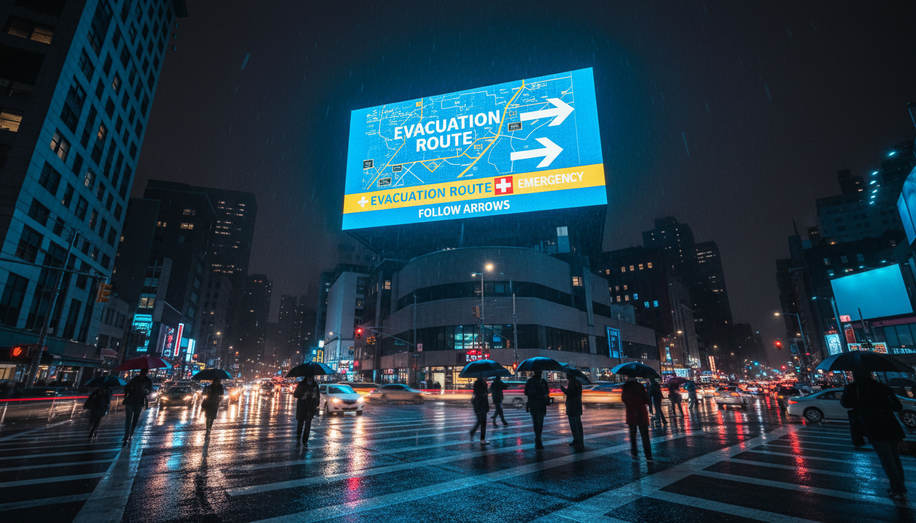

When disaster strikes, traditional communication channels often become overwhelmed or unreliable. During hurricanes, floods, wildfires, or public health emergencies, the systems people typically depend on—social media, email, broadcast television—face network congestion, power outages, or simply fail to reach certain populations. In these critical moments, out-of-home advertising emerges as an unsung hero of crisis communication, delivering life-saving information to millions of people exactly when they need it most.
The unique strength of OOH lies in its ubiquity and immediacy. Billboards dot highways where evacuees are fleeing danger. Transit advertisements reach commuters during their daily routines. Digital displays in shopping centers catch the attention of people moving through public spaces. Unlike digital channels that require internet connectivity or specific device ownership, OOH reaches people in their physical environments, making it a genuinely universal communication tool. During the COVID-19 pandemic, when confusion and misinformation spread rapidly online, out-of-home platforms proved instrumental in delivering consistent, authoritative public health messaging to diverse populations across the United States.
What makes OOH particularly valuable during crises is its visual impact combined with simplicity. Emergency communications cannot be buried in lengthy text or complex explanations. A billboard displaying “#StayHome. Save lives.” or a transit advertisement promoting evacuation routes must communicate instantly and clearly. The inherent design constraints of OOH—bold colors, large typography, minimal copy—naturally lend themselves to the directness required during emergencies. When seconds can mean the difference between safety and danger, clarity becomes a life-or-death consideration.
The hyper-local nature of OOH advertising adds another critical dimension to crisis response. During natural disasters, government agencies and emergency management teams need to communicate different messages to different regions. A flooding emergency in one county requires different instructions than wildfire evacuation procedures in another. OOH’s geographic flexibility allows officials to tailor messaging precisely where it’s needed, ensuring that residents receive contextually appropriate guidance without confusion caused by irrelevant information.
Moreover, OOH fills communication gaps that other media simply cannot address. Rural communities with limited broadband access, economically disadvantaged neighborhoods, and populations with lower digital engagement remain critically vulnerable to information blackouts during crises. When a hurricane approaches a rural area, residents without reliable internet access cannot benefit from social media alerts or email notifications. Yet billboards, transit ads, and outdoor posters reach these populations regardless of their technological access or digital literacy. This democratization of emergency information is particularly crucial for protecting the most vulnerable members of our communities.
The industry has demonstrated genuine commitment to this public safety mission. During recent emergencies, OOH platforms have rapidly donated inventory to amplify government messaging, often at significant cost. The OOH Squad actively partners with state transportation departments on safety initiatives, creating infrastructure specifically designed to support critical communications. This collaborative spirit between the industry and public agencies strengthens the entire emergency communication ecosystem.
Integration with multi-channel strategies further amplifies OOH’s effectiveness during crises. Someone might first encounter a public health warning through a news alert, then reinforce that message through a social media post, and finally see concrete instructions on a billboard while driving to a testing site or emergency shelter. This repetition across multiple touchpoints dramatically improves message retention and behavioral response when time-sensitive action is essential.
As communities face increasingly complex emergencies—from cyber threats to climate-related disasters—the role of reliable, accessible communication channels becomes ever more critical. Out-of-home advertising has proven itself as far more than a commercial tool; it is essential public infrastructure for crisis communication. By maintaining strong relationships between OOH providers and emergency management agencies, and by continuing to innovate in how outdoor platforms can serve public safety needs, the industry ensures that when every second counts, critical lifesaving information reaches everyone who needs it.