

Location-Based Marketing in OOH: Trends and Innovations Shaping the Next Wave of Outdoor Advertising
Meta description: Location-based marketing is reshaping OOH. How brands use data, mobile signals, and context to deliver smarter outdoor campaigns.
Location-based marketing in OOH has moved from crude proximity targeting to a data-rich, highly measurable discipline. Brands now treat billboards, transit shelters, and street furniture as addressable media, informed by mobile movement patterns and real-time context. The result is a new class of outdoor campaigns that look more like dynamic digital media than static posters.
The scale is significant. Research on the broader location-based advertising market forecasts global spend rising from around 123 billion dollars in 2024 to more than 140 billion dollars in 2025, with OOH a visible beneficiary as more inventory becomes digital and programmatic. Advertisers are redirecting budgets from broad, awareness-only buys toward targeted placements linked to store visitation and app activity, particularly in retail, QSR, and entertainment.
Industry trends and market overview
Digital OOH penetration is the foundation of this shift. In the US, digital formats now account for roughly a third of OOH spend, growing faster than static inventory as advertisers prioritize flexible, data-driven placements. Programmatic OOH is projected to surpass 1 billion dollars in spend, as buyers seek the same levers they use in online display and video: audience targeting, dayparting, and automated optimization.
Creative formats are evolving alongside the pipes. Augmented reality overlays, weather-triggered messaging, and context-aware “smart” billboards are becoming more common in urban corridors, transport hubs, and high-footfall retail districts. Market analyses highlight AR-enhanced OOH delivering engagement rates several times higher than traditional static displays, with interaction times measured in tens of seconds rather than fleeting glances.
From geofencing to behavior-led planning
Location-based OOH targeting is no longer just about dropping a pin around a store. Agencies increasingly blend geotargeting, historical movement data, and behavioral segments to plan screens along real customer journeys. Guides to location-based advertising describe how GPS, Wi‑Fi, and IP data can define tight catchment areas, identify commuter corridors, or isolate audiences attending specific venues, while more advanced methods like georetargeting refine these groups over time.
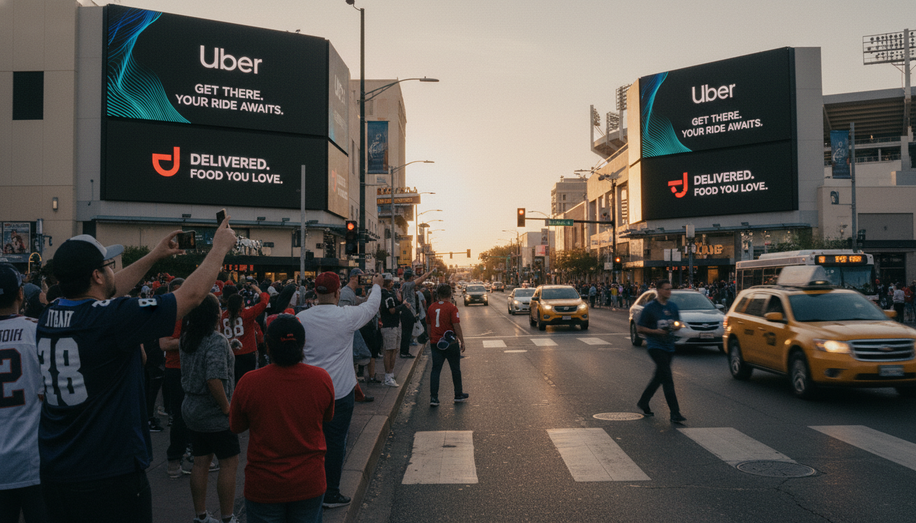
The same thinking shapes messaging. Contextual creative now reflects local landmarks, neighborhoods, or live events to increase relevance and recall. Industry practitioners point to examples such as food delivery services tailoring billboard copy by district or brands serving different messages around sports stadiums on game days versus off days. This form of hyperlocal storytelling aligns with findings that location-referenced messaging drives stronger engagement and conversion intent.
Case studies around major events
Major events are proving ground for location-led OOH innovation. During large sports tournaments and citywide festivals, media owners use real-time mobility data to identify hotspots, reallocate impressions, and rotate creatives across screens in response to changing crowds. Reports on recent OOH campaigns describe weather-reactive displays outside stadiums that switch between refreshment messages as temperature rises, or transport ads triggering different slogans based on match schedules and rush-hour patterns.
AR-enhanced murals and experiential placements have also become fixtures around such events. Industry trend analyses cite AR murals near venues that unlock team content or brand experiences when viewed through a smartphone, often supported by 5G to reduce friction. These activations tend to generate social amplification as fans share content, with some sources indicating AR OOH experiences can deliver several hundred percent higher engagement than static alternatives.
Measurement, attribution, and ROI signals
The most significant change underpinning these trends is measurement. Location intelligence providers now claim geofencing accuracy to within about one meter in some contexts, allowing more precise footfall attribution and cleaner control versus exposed studies. Confidence intervals above 90 percent are increasingly used as proof points when tying OOH exposure to store visits or app usage uplifts, giving media buyers more confidence in ROI than in earlier eras of panel-based estimates.
Cross-channel attribution is also tightening the loop. By linking anonymized device IDs across mobile, OOH, and other digital channels, marketers can assess whether a roadside screen influenced later online search, website visits, or in-app purchases. Industry sources report that OOH can boost foot traffic by 80 to 120 percent versus mobile-only campaigns in certain scenarios, especially when used as a prompt near key decision points such as retail clusters or transport interchanges.
Privacy, sustainability, and future direction
These advances bring scrutiny. Practitioners stress the need to comply with privacy regulations and maintain transparent data practices when using precise location signals, especially in dense urban settings. Industry guidance emphasizes consent-based data collection, aggregated reporting, and avoiding overly granular audience slices that could risk re-identification.
Sustainability considerations are also reshaping the market. Analyses of OOH’s environmental footprint note that while the medium accounts for a small share of total advertising power consumption in markets like the UK, media owners are moving to unified carbon measurement frameworks, renewable energy sourcing, and solar-powered digital screens. This shift allows brands to balance performance goals with corporate climate commitments as they scale location-based OOH activity.
For advertisers, the direction of travel is clear. As digital inventory grows, measurement improves, and location data becomes more precise, OOH is evolving into a fully accountable, audience-led channel. The brands that benefit most will be those that treat location-based marketing not as a gimmick but as a disciplined practice, combining context-aware creativity with robust attribution and clear guardrails on privacy and sustainability.