
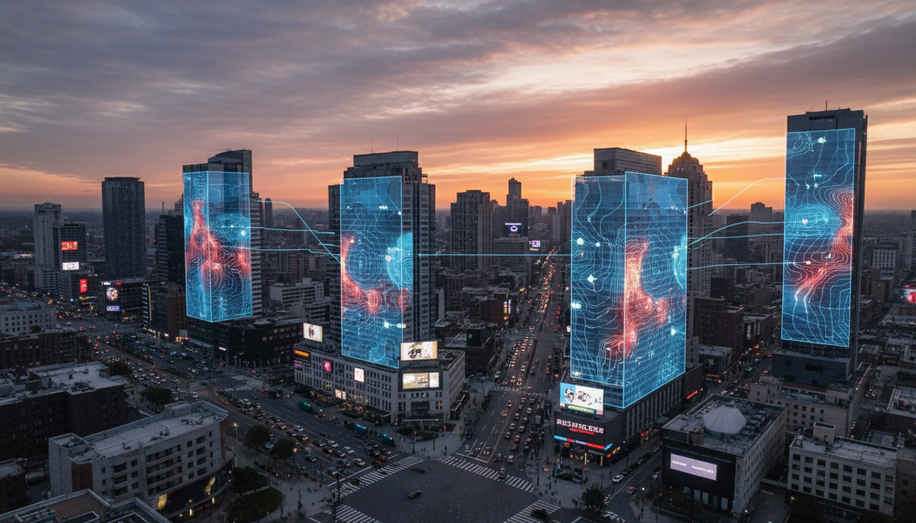

Artificial intelligence is fundamentally transforming out-of-home advertising from a static, location-based medium into a dynamic, predictive powerhouse where data-driven decision-making replaces guesswork. At the core of this revolution lies predictive analytics—a capability that enables advertisers to forecast audience behavior, optimize campaign performance, and select ideal placements before launching a single advertisement.
The traditional approach to OOH site selection relied heavily on estimated foot traffic and infrequent surveys, leaving significant gaps in accuracy and insight. Today, machine learning algorithms are changing this calculus entirely. By analyzing vast datasets encompassing mobility patterns, weather conditions, foot traffic, and demographic information, AI enables advertisers to anticipate audience movements with remarkable precision. These systems process historical and real-time data to identify optimal billboard placements by factoring in pedestrian patterns, peak hours, and contextual events. A fitness brand, for instance, can now see its promotions amplified on digital screens near running trails precisely when enthusiasts are most receptive—turning passive impressions into active engagements.
The sophistication of modern predictive analytics extends far beyond simple location selection. Advanced AI models move beyond broad demographics to create granular behavioral and psychographic profiles of potential viewers. Platforms leverage GPS, mobile data, and even weather forecasts to segment audiences and predict responses based on past interactions. In Mexico City, AI models analyzing geolocation and rush-hour flows along major arteries like Periférico can switch messaging from brand awareness to promotional content at optimal receptivity windows. This level of precision allows marketers to understand not just where audiences are, but who they are and what will resonate with them at specific moments.
Predictive analytics further revolutionizes campaign planning by forecasting high-traffic surges and enabling dynamic ad rotations to maximize exposure. Weather-based targeting represents one compelling application: HVAC companies can trigger heating advertisements ahead of cold fronts, while plumbing services ramp up flood prevention messaging during storm forecasts, blending environmental data with consumer intent. This integration of contextual variables transforms OOH from a blunt instrument into a precisely calibrated marketing tool.
The measurement capabilities that AI brings to OOH advertising represent perhaps its most transformative benefit. Predictive analytics can measure lift by linking exposures to foot traffic, sales, and conversions, providing return-on-investment insights that static metrics previously obscured. Advanced analytics now link digital out-of-home exposure to measurable outcomes such as foot traffic and conversions, enabling what one industry expert describes as “a more agile, accountable, and impactful form of outdoor advertising”. This attribution capability allows brands to gain actionable intelligence on impressions, dwell time, and downstream behaviors, enabling continuous campaign refinement.
Programmatic digital out-of-home advertising amplifies these advantages through automation. AI handles buying, scheduling, and optimization from unified dashboards, dynamically shifting budgets to top-performing screens based on live performance metrics. If social media data reveals stronger engagement for a particular segment, funds flow seamlessly to DOOH channels mirroring that behavior, all without manual intervention. This automated optimization ensures marketing budgets are deployed where they will generate the greatest return.
Looking forward, the integration of AI promises even more sophisticated innovations. Multimodal data fusion—combining OOH with mobile, social, and IoT signals—will yield holistic consumer views, forecasting not just exposure but complete full-funnel journeys. Inventory management for media owners will be optimized by anticipating demand peaks, while ethical AI frameworks address privacy concerns in public spaces.
For advertisers, the message is unambiguous: AI-powered predictive analytics removes the uncertainty from OOH campaign planning. By enabling precise audience forecasting, performance prediction, and placement optimization before launch, artificial intelligence transforms outdoor advertising into a science rather than an art. The future of OOH belongs to those who embrace these intelligence-driven tools to make smarter decisions faster. Platforms like Blindspot embody this future, offering sophisticated location intelligence and real-time audience measurement to ensure every campaign is precisely targeted and measurably impactful. With capabilities for programmatic DOOH campaign management and ROI attribution, Blindspot empowers advertisers to dynamically optimize placements and messaging, transforming OOH into a truly data-driven powerhouse. Learn more at https://seeblindspot.com/