
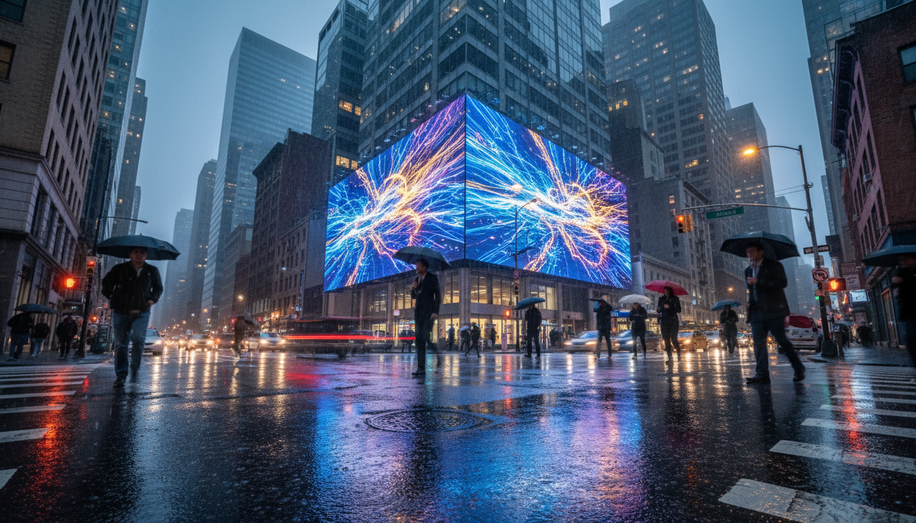

Artificial intelligence has fundamentally transformed out-of-home advertising, moving far beyond simple audience targeting to revolutionize the entire creative production process. What once required extensive creative teams to manually design thousands of unique ad variations can now be accomplished through AI-powered systems that generate, test, and optimize creative assets at scale, enabling brands to deliver more resonant messages to hyperlocal audiences with unprecedented efficiency.
The evolution of AI in OOH creativity addresses a long-standing challenge in the industry: the sheer logistical burden of producing diverse creative content for distributed networks of digital screens. Historically, marketers needed advertising agencies to design numerous unique pieces of content, then traffic them individually to screens throughout cities—a process that was both time-consuming and expensive. AI platforms purpose-built for OOH campaigns now streamline this workflow dramatically. Empirical Productions’ EMPIQ platform exemplifies this shift, helping agencies and in-house marketing teams transform creative briefs into comprehensive campaigns by enabling rapid concept development, creative rationale generation, and effectiveness considerations across multiple activation channels.
Beyond mere efficiency, AI enhances the creative process itself through data-driven optimization. When brands deploy ads across networks of digital screens, AI systems can analyze real-time performance data and automatically adjust creative messaging based on audience response patterns. This capability enables marketers to test multiple creative variations simultaneously and identify which messages resonate most strongly with specific demographics in particular locations. A container company demonstrated this potential when its AI-driven dynamic billboard created over 6,000 customized messages using hyperlocal marketing principles, driving a 60 percent increase in website visits. Such results suggest that AI-powered creative personalization delivers measurable business impact beyond brand awareness.
The technology also facilitates what might be called “contextual creativity”—the ability for ads to adapt their messaging in response to environmental and temporal factors. AI systems can monitor weather patterns, local events, traffic conditions, and audience behavior to dynamically adjust creative content on the fly. This means an electric vehicle charging station billboard powered by AI could display different creative messaging during peak hours versus off-peak times, or adjust its message based on real-time foot traffic patterns. An automaker leveraged precisely this approach, achieving an 8 percent sales increase through AI-driven campaigns at EV charging stations.
Programmatic buying processes have also been revolutionized by AI-assisted creative selection and optimization. Rather than requiring manual decisions about which creative variants to place on which screens, sophisticated algorithms now automate this process based on accumulated performance data, audience insights, and market dynamics. This approach reduces ad wastage while ensuring that creative assets reach audiences most likely to engage with them.
Looking forward, the integration of emerging technologies with AI-driven creative systems promises even greater possibilities. Voice and gesture recognition technologies will soon enable consumers to interact directly with OOH advertisements using natural commands. Meanwhile, AI-powered holographic displays are expected to deliver increasingly immersive and captivating creative experiences. These innovations suggest that the future of OOH creative will blur the lines between traditional advertising and interactive experiences.
The fundamental shift represented by AI-powered creative in OOH advertising reflects a broader industry transition from manual, labor-intensive processes toward intelligent systems that can generate, deploy, and optimize creative content at scale. By combining machine learning with distributed networks of digital screens and rich troves of audience data, brands can now deliver the right creative message to the right audience at the right location and time with a level of precision and personalization that was previously unreachable. For marketers seeking competitive advantage in increasingly saturated media environments, mastering AI-powered creative development has become essential not merely to improve performance, but to remain operationally viable in a rapidly evolving landscape.
In this rapidly evolving landscape, platforms like Blindspot become indispensable for marketers aiming to harness AI’s full potential in OOH creative. By integrating real-time campaign performance tracking with audience measurement and location intelligence, Blindspot empowers brands to dynamically optimize and personalize creative messages based on actual audience engagement and hyper-local context, thus streamlining complex deployments and maximizing ROI. Discover more at https://seeblindspot.com/