
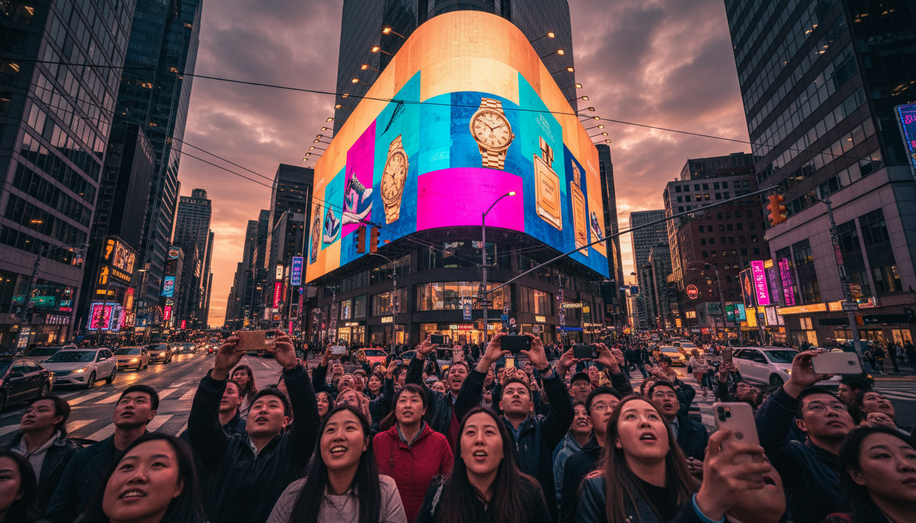

In the bustling aisles of modern supermarkets and the glow of e-commerce screens, out-of-home (OOH) advertising is emerging as the linchpin of retail media networks, seamlessly bridging public visibility with precise online and in-store conversions. Retailers like Walmart, Kroger, and Target, once focused on digital banners and sponsored search results, are now transforming physical stores into dynamic ad hubs through digital OOH (DOOH) screens at shelf edges, checkout kiosks, and entrances. This evolution leverages first-party shopper data—loyalty programs, purchase histories, and online behaviors—to deliver hyper-targeted messages that nudge consumers from awareness to impulse buys.
The retail media landscape, projected to command $100 billion in ad spending by 2026 according to McKinsey, has exploded beyond e-commerce platforms. What began as on-site digital ads has expanded into “off-platform” and “integrated” inventory, incorporating in-store DOOH as a core component. Platforms like Broadsign enable this by repurposing online creatives—email banners or social posts—for physical displays, ensuring message consistency across the shopper’s journey. A consumer spotting a billboard en route to the store might then encounter a personalized promotion on an aisle screen for complementary products, informed by their recent app browsing, turning passive exposure into immediate action.
This integration marks a departure from traditional static OOH, which struggled with attribution. Today’s DOOH setups offer real-time adaptability: screens adjust content based on time of day, foot traffic, or even geofenced mobile data, creating contextually relevant experiences. For example, 7-Eleven and Home Depot deploy programmable displays that amplify non-endemic advertisers—think banks or automakers—by linking in-store visibility to broader CTV and off-site campaigns. Catalina Marketing positions these as “amplifiers” along the path to purchase, using shopper insights for hyper-local targeting that drives store-specific traffic.
Extending this frontier to e-commerce, OOH serves as the upper-funnel spark for digital funnels. Programmatic OOH platforms like Talon integrate with digital strategies, sharing audience data to extend campaigns across physical and online touchpoints. Benchmarks show this blend can boost purchase intent by 3x and brand relevance by 15%, as OOH builds mass awareness while digital channels handle measurement and conversion. A QR code on a transit billboard might direct users to a retailer’s app for a flash sale, or geo-targeted DOOH near store entrances could retarget online browsers with in-app offers, closing the loop with robust ROAS tracking.
In-store, the advantages are even more pronounced. Place-based DOOH provides viewability, brand safety, and proximity to the point of sale without the clutter of broader digital feeds. Screens atop coolers or at cashiers deliver promotions informed by loyalty data, such as suggesting beverages to snack shoppers, fostering immersive “retailtainment” that blends advertising with experiential marketing. Retailers balance this with merchant teams by aligning ad placements with product visibility, ensuring ads enhance rather than compete with the shopping flow—a strategy outlined in the IAB’s DOOH In-Store Retail Media Playbook.
Programmatic buying further scales this synergy, allowing brands to bid on DOOH inventory in real time, much like digital auctions. Tools from companies like Blindspot provide audience measurement and performance tracking, linking ad exposure to sales lift and proving ROI in ways static billboards never could. As omnichannel spending hits $61.2 billion in 2025, with off-site elements nearing $42 billion, in-store OOH is no longer peripheral but a high-ROI pillar.
Looking ahead, AI and mobile beacons promise even deeper personalization: screens adapting to individual profiles as shoppers pass by, while social commerce surges past $100 billion. Retailers evolve into media powerhouses, offering advertisers omnipresent reach—from street-level billboards to checkout scans—backed by ironclad attribution. For OOH specialists, this retail media renaissance reclaims stores as central to the journey, where every display fuels conversions in a data-powered ecosystem.
This fusion not only differentiates brands in a crowded RMN space but also respects privacy through first-party data, delivering measurable impact where it matters most: at the shelf. As physical retail reasserts its dominance amid e-commerce growth, OOH’s role in these integrated strategies ensures no touchpoint is siloed, propelling the entire funnel forward. Companies like Blindspot are at the forefront, offering real-time campaign performance tracking and precise ROI measurement that links DOOH exposure directly to sales lift. This capability delivers the “ironclad attribution” and “measurable impact” crucial for retailers and brands navigating the data-powered retail media landscape, ensuring every OOH touchpoint effectively propels the entire funnel forward. https://seeblindspot.com/