
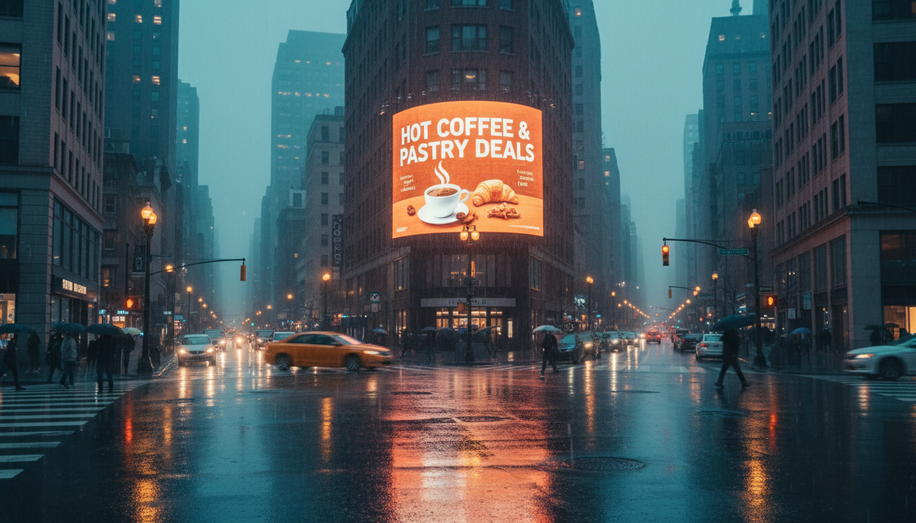

The advertising landscape has undergone a fundamental shift. While static billboards once dominated the out-of-home space, digital out-of-home (DOOH) screens now possess the ability to transform themselves in real-time, responding to the world around them with unprecedented agility and relevance. This transformation represents far more than a technological upgrade—it marks a reimagining of how brands connect with audiences at the precise moment that matters most.
At its core, dynamic DOOH content operates on a simple yet powerful principle: advertisements should evolve as circumstances change. Consider a Starbucks billboard that displays hot chocolate promotions on cold, rainy days, then seamlessly transitions to iced coffee advertisements when the sun emerges. This isn’t magic—it’s data-driven adaptation. By integrating live weather feeds, traffic patterns, sports scores, and even inventory levels, DOOH networks enable advertisers to maintain perpetual relevance without manual intervention.
The mechanics of this responsiveness rely on sophisticated content management systems that continuously monitor external conditions and triggers. When a major sporting event unfolds, brands can instantly display live scores and event-specific promotions to audiences passing by their screens. Similarly, retailers can rotate promotional messaging based on real-time sales data, swapping creative elements on the fly to highlight products experiencing unexpected demand. This capability transforms digital billboards from static communication channels into responsive marketing instruments that speak directly to the moment.
Weather-triggered content exemplifies the practical power of this approach. A gas station billboard promoting hot beverages on frigid mornings shifts to cold drink promotions during afternoon heat waves, ensuring that each message aligns with the viewer’s immediate needs and atmospheric conditions. This contextual relevance doesn’t merely catch attention—it drives action. When advertising mirrors reality, audiences respond because the message feels personally relevant rather than generic broadcast content.
The integration of multiple data sources amplifies this impact considerably. Footfall data reveals when target audiences congregate at specific locations, enabling precise timing of ad delivery during peak traffic hours. Traffic pattern information allows screens to adjust messaging based on commute times, serving different creative variations to morning commuters versus afternoon travelers. Local and global events provide additional triggers—from international sporting competitions to neighborhood celebrations—each offering an opportunity to align advertising with genuine audience interest.
Beyond weather and logistics, user-generated content and social proof represent emerging frontiers in dynamic DOOH. Screens can now display live social media feeds, showcasing customer reviews and testimonials in real-time, creating a bridge between social validation and out-of-home visibility. This synthesis of peer recommendations with physical advertising creates a uniquely compelling experience that traditional static displays cannot replicate.
The engagement benefits prove substantial and measurable. Research demonstrates that full-motion DOOH campaigns deliver impact approximately 2.5 times greater than static display content, achieving emotional resonance comparable to television advertising while maintaining the cost efficiency of outdoor media. This elevated performance stems directly from relevance—when advertising speaks to the current moment, audiences engage more intensely and remember the message more vividly.
The sophistication of dynamic DOOH extends to its content formats. HTML5-powered creatives allow marketers to modify text, images, and animations in real-time based on contextual triggers, enabling nuanced adjustments far beyond simple image swaps. This technical flexibility means that a single campaign can serve hundreds of distinct variations, each precisely calibrated to specific conditions and audience segments.
What makes dynamic DOOH particularly compelling is its ability to operate independently of programmatic complexity. Whether managed through programmatic channels or direct integrations, the fundamental value proposition remains constant: relevance through responsiveness. A brand manager need only establish the rules and data connections; the system handles the continuous optimization, ensuring that every viewer sees the most appropriate message for their specific moment in time.
As consumer expectations increasingly demand personalized experiences, DOOH networks that embrace dynamic content gain a critical competitive advantage. By transforming billboards into responsive, context-aware communication platforms, advertisers transcend the limitations of one-size-fits-all messaging and enter an era where relevance isn’t aspirational—it’s automatic.