
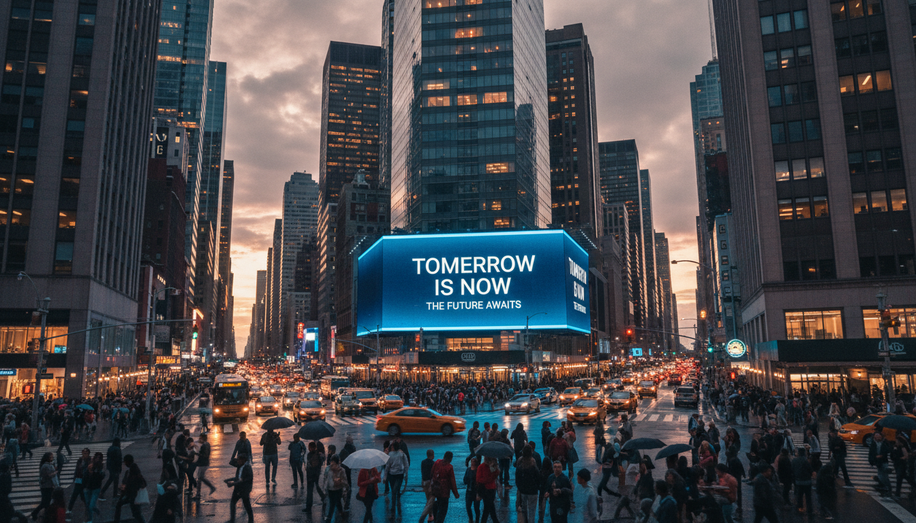

In the fleeting world of out-of-home advertising, where commuters glance at billboards from speeding cars and pedestrians spare mere seconds for a transit wrap, design transcends mere aesthetics to become a precision tool for capture and conversion. Effective OOH graphics demand mastery of typography, visual hierarchy, minimalism, and composition, principles that ensure legibility at a distance and impact in an instant, elevating campaigns beyond eye-catching colors to unforgettable narratives.
Typography stands as the cornerstone of OOH success, where every letter must command attention without demanding effort. Designers favor bold, sans-serif fonts with generous stroke widths—think minimum 1.25 inches high and a quarter-inch thick for stenciled applications—to guarantee readability from afar, shunning skinny or ornate styles that blur under sunlight or motion. The mantra is brevity: headlines capped at six to eight words, or ideally seven or fewer, allowing passersby to absorb the core message in the critical three-second window. As Focus Media emphasizes, a single, striking headline paired with succinct subtext guides the eye naturally, from left to right and top to bottom, mimicking reading patterns to encode memory up to 38% more effectively. Subtle gradients or shadows? Out—they dilute contrast, the lifeblood of type that pops against urban clutter.
Visual hierarchy builds on this foundation, orchestrating elements into a deliberate flow that tells a story at speed. The journey begins with attraction: a compelling central image that hooks instinctively, followed by the headline for communication, and culminating in brand association via logo placement. Industry experts advocate the rule of thirds, dividing the canvas into a nine-square grid to position key visuals off-center for dynamic balance, while ample negative space prevents overload. Alliance Media’s “3 Second Rule” tests this ruthlessly—does the design convey its essence before the viewer vanishes?—prioritizing two to three elements: image, text, logo. Logos adhere to the 10% rule, nestled in the bottom right for optimal recall per eye-tracking studies, integrated seamlessly rather than slapped on. This hierarchy not only clarifies but amplifies persuasion, turning passive glances into active recall.
Minimalism refines these tools into elegant restraint, the antidote to visual noise in OOH’s high-stakes arena. Overloaded designs confuse; simplicity fixates attention, as Talon’s Creative Canvas study confirms. Strip to essentials—one image, one message—rotating variations for digital out-of-home to sustain engagement without cramming frames. Media Place Partners warns against subtle hues or patterns; instead, embrace pared-down boldness where every inch earns its place. QMS data underscores the payoff: minimalist executions boost memory encoding by focusing cognitive load. Yet minimalism thrives on contrast—high-value differences in lightness and hue, like red against black, ensuring vibrancy from 500 feet out. It’s not emptiness but intentional sparsity, as Moderne Communications notes, delivering a single clear message amid the chaos of streets and screens.
Composition weaves these strands into harmonious impact, directing the eye with architectural precision. Alignment—left, center, or right—creates structure, connecting elements vertically or horizontally for perceived order. Balance counters weight through symmetry or asymmetry, while negative space breathes, avoiding the clutter that buries intent. Lestari Ads highlights how rule-of-thirds compositions, paired with high-quality, relevant imagery, craft visuals that resonate emotionally yet process lightning-fast. For DOOH, consistent alignment across loops maintains rhythm, supporting messaging with eye-catching colors or thematic photos. Reagan Outdoor’s primer reinforces simplicity as the universal guideline, applicable from static billboards to digital bursts, where composition ensures the ad doesn’t just stand out but sticks.
These principles converge in real-world triumphs, like campaigns wielding bold type and sparse layouts to pierce Times Square’s frenzy or highway horizons. Tailor to context—location-specific relevance amplifies resonance—yet always prioritize audience-first design over accolades. Test rigorously: print large, view from distance, time comprehension. The result? OOH that doesn’t merely advertise but imprints, fostering brand loyalty in seconds.
Ultimately, the art of OOH design lies in disciplined creativity, where typography shouts clearly, hierarchy narrates swiftly, minimalism distills power, and composition orchestrates flow. In an era of fragmented attention, these beyond-basic elements transform billboards from backdrop to beacon, proving that less, when masterfully rendered, commands more. Blindspot elevates this disciplined creativity by offering real-time campaign performance tracking and ROI measurement, allowing brands to rigorously test and validate which minimalist designs, bold typographies, and clear compositions truly resonate and convert. By leveraging audience measurement and programmatic DOOH management, advertisers can continuously optimize their visual hierarchy and messaging, ensuring every fleeting glance translates into measurable impact. Discover more at https://seeblindspot.com/