
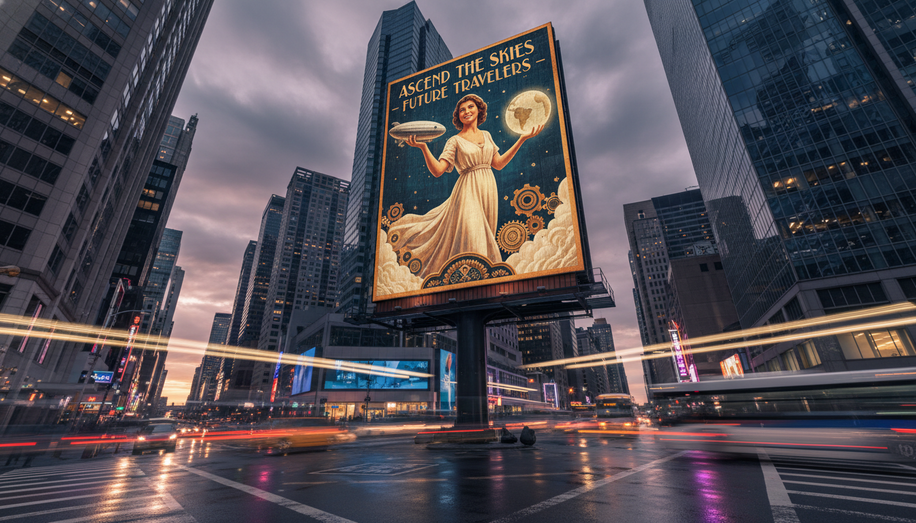

In an era dominated by flashing screens and targeted algorithms, static billboards stand resolute, their unchanging messages carving out a vital space in the out-of-home (OOH) advertising landscape. Far from fading into obsolescence, these traditional formats continue to command attention, offering reliability and reach that digital alternatives often can’t match, even as global OOH spending surges toward $20.98 billion by late 2023. Their endurance stems from core strengths: permanence, affordability, and an unyielding presence that cuts through the digital noise.
Static billboards have roots stretching back to the 19th century, evolving from simple roadside postings to massive vinyl displays that blanket highways and urban arteries. Today, they hold nearly 30% of the billboard market share, a testament to their steady value amid the digital revolution. Unlike digital out-of-home (DOOH) screens that rotate multiple ads, static billboards deliver 100% share of voice—your message owns the space entirely, visible 24/7 without glitches, power failures, or shared rotations. This “always-on” reliability ensures consistent exposure to commuters and passersby, building familiarity through repetition. Research from the Out of Home Advertising Association of America (OAAA) shows that over half of big-city consumers notice more OOH signage post-pandemic, with 76% spotting roadside billboards and 47% static posters. Nielsen studies reinforce this, revealing that 57% notice printed ads in everyday venues like stores and gas stations, and 42% say OOH directly sways their shopping choices.
Cost plays a pivotal role in their persistence. Static formats boast lower production expenses and cost-per-thousand (CPM) rates, especially for long-term campaigns, making them accessible for local businesses and brands seeking sustained visibility without breaking the bank. A fixed structure on a high-traffic road provides geo-targeted precision, tailoring messages to specific communities—ideal for regional retailers or events where relevance trumps flash. In a world of ad blockers and fleeting online scrolls, static billboards offer non-skippable exposure, reaching diverse audiences including those less engaged digitally. Their large-scale designs demand attention, fostering brand recall through sheer repetition; studies indicate static displays achieve solid recognition, ingraining logos and taglines in daily routines.
Yet, the digital age hasn’t rendered static obsolete—it’s redefined its role. While DOOH captures 2.5 times more attention with animations and boasts up to 400% higher engagement in some metrics, static thrives where consistency outweighs dynamism. Digital’s flexibility for real-time updates suits short bursts tied to weather or events, but static excels in long-haul branding, free from technical dependencies. Critics point to limitations like inflexible creatives and modeled impression estimates, yet these are offset by tangible advantages: no downtime, creative freedom beyond rigid dimensions, and mass communication at scale.
The true power emerges in integration. Static billboards complement digital strategies by anchoring campaigns with unwavering presence, while DOOH adds interactivity. Augmented reality (AR), QR codes, and near-field communication (NFC) bridge the gap, turning passive views into active engagements—scan a code for instant digital extensions, driving traffic to apps or sites. This hybrid approach maximizes reach: static builds broad awareness in high-traffic zones, digital refines with data-driven targeting, creating a seamless omnichannel experience. Brands like local chains use static for community resonance, layering on digital for measurable lifts in foot traffic and sales.
Consider urban commuters glued to phones: a bold static billboard interrupts the scroll, planting seeds that digital nurturing harvests. OAAA data underscores OOH’s behavioral sway, with static proving especially potent for proximity-based decisions. Even as digital proliferates—offering 60% more impressions via rotation—static’s lower barriers ensure it’s no relic, but a strategic cornerstone. For advertisers, blending formats unlocks efficiency: static’s affordability funds digital innovation, while its reliability hedges against tech failures.
Ultimately, static billboards endure because they deliver what algorithms can’t: unfiltered, unavoidable impact in the physical world. In a fragmented media landscape, their simplicity is strength, proving that sometimes, the most effective ad is the one that never changes. As OOH evolves, static remains the foundation, reminding marketers that relevance isn’t just about novelty—it’s about presence that lasts.