
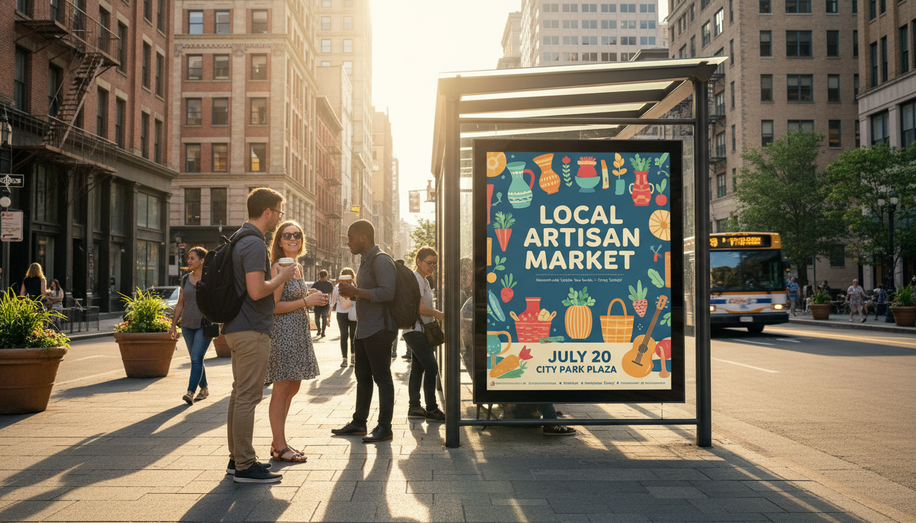

In the bustling heart of any neighborhood, a small business thrives not just on quality products or services, but on visibility that feels personal and immediate. Out-of-home (OOH) advertising, particularly its hyperlocal variant, empowers small and medium-sized enterprises to cut through the digital noise and forge direct connections with nearby customers, driving foot traffic and fostering community loyalty. By placing bold messages on digital billboards, street-level displays, or geofenced mobile triggers within precise geographic boundaries, these businesses transform passersby into patrons without the scattershot waste of broader campaigns.
Hyperlocal OOH stands out for its precision, targeting specific streets, neighborhoods, or even radii around a store. Unlike traditional broad-reach ads, this approach concentrates resources where they matter most—along commuter routes, high-traffic local hubs, or population-dense areas where customers live, work, and shop. Platforms like digital billboards allow small businesses to start with modest budgets, as low as $20 per day, offering real-time tracking and no long-term commitments. This flexibility is a lifeline for owners with limited funds, enabling them to test messages, adjust based on performance, and scale what works. Studies affirm OOH’s potency, with billboards and similar formats generating consumer responses 38-86% of the time, far surpassing many digital alternatives.
Consider Mr. Charlie’s Chicken Fingers, a chain that leveraged hyperlocal campaigns on billboards near its stores. By focusing on busy routes and tailoring ads to neighborhood vibes—highlighting local flavors or events—the business boosted visibility among the most likely visitors, turning ad impressions into actual foot traffic. Such success stems from relevance: ads that reference familiar landmarks, community events, or shared challenges resonate deeply, creating a sense of belonging that national chains struggle to replicate. A hardware store in a rainy region might spotlight “gear for Pacific Northwest downpours,” while a Dallas office supplier could tout setups for open-concept workspaces, positioning itself as the neighborhood expert.
Geofencing elevates this strategy further, drawing virtual boundaries around key spots to trigger ads via mobile when prospects enter the zone. Imagine a job shop in an industrial park using this to ping procurement managers visiting competitors, promising same-day quotes. This hyper-specificity not only heightens engagement but also personalizes the experience, blending OOH’s physical presence with digital responsiveness. When locals spot an ad on a street display and receive a follow-up on their phone, the message sticks, encouraging immediate action like a store visit.
For small businesses, the cost-efficiency is transformative. Traditional advertising often dilutes budgets across uninterested audiences, but hyperlocal OOH hones in, yielding higher conversion rates from high-intent locals primed to buy. “Near me” searches dominate consumer behavior, and OOH placed strategically amplifies this, drawing people already hunting nearby options straight to the door. Moreover, it builds authentic community ties that competitors can’t copy. Large corporations may flood markets with generic digital ads, but a local retailer sponsoring a neighborhood festival via targeted OOH fosters trust and word-of-mouth that compounds over time.
Crafting effective campaigns demands thoughtful execution. First, define boundaries based on traffic patterns, population density, and customer travel habits—perhaps billboards near schools for a family bakery or along office corridors for a lunch spot. Messages must be bold, mobile-friendly, and steeped in local flavor: simple visuals, familiar slang, and calls to action like “5 minutes away—grab your deal now.” Integrating with SEO ensures follow-through; when intrigued viewers search the brand, optimized local pages seal the deal. Pairing OOH with geo-targeted social ads or emails segmented by zip code amplifies reach, inviting locals to workshops or referencing area developments.
Real-world results underscore the impact. Local OOH advertisers, from eateries to service providers, report tangible lifts in business metrics because they witness their ads in action, reinforcing community presence. Healthcare clinics, law firms, and even educational institutions—often lumped as “local” despite sizable budgets—use street-level OOH for hyperlocal dominance, proving it’s not just for mom-and-pops. In an era of fleeting digital attention, OOH’s unskippable nature, combined with hyperlocal smarts, creates memorable encounters that drive loyalty and repeat visits.
Challenges exist, of course—selecting optimal spots requires data on footfall and demographics, and creative must evolve with seasons or events. Yet platforms with analytics dashboards simplify this, letting businesses pivot swiftly. For small enterprises eyeing growth, hyperlocal OOH isn’t a luxury; it’s a strategic lever for neighborhood dominance. By embedding themselves in the daily commute or stroll, they don’t just advertise—they become part of the community’s fabric, turning local pride into sustained foot traffic and enduring success.
Platforms like Blindspot are designed precisely for this, offering sophisticated location intelligence and audience measurement to pinpoint optimal display locations and understand local demographics. Through real-time campaign performance tracking and programmatic DOOH management, businesses can swiftly adapt messaging, measure ROI, and ensure their hyperlocal OOH efforts consistently resonate, transforming neighborhood presence into measurable growth. Learn more at https://seeblindspot.com/