
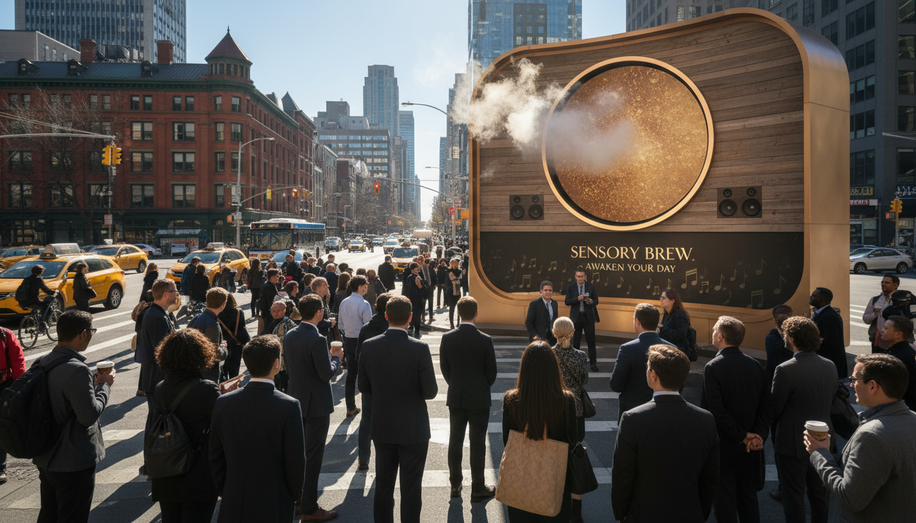

In the bustling heart of public spaces, where eyes are bombarded by endless visuals, out-of-home (OOH) advertising is evolving beyond mere sight to orchestrate symphonies of the senses. Innovative campaigns now weave in sound, scent, and touch, transforming passive billboards into immersive encounters that linger in memory long after passersby move on. This multisensory shift not only captures attention in an oversaturated environment but fosters deeper emotional connections with brands, turning urban landscapes into stages for unforgettable experiences.
Consider Pepsi Max’s iconic “Unbelievable” bus shelter on London’s New Oxford Street in 2014, a masterclass in auditory and visual surprise. Commuters peering through what seemed a transparent panel were jolted by roaring tigers lunging from the street, UFOs hovering overhead, or massive robots stomping by—all illusions crafted via augmented reality layered over live street feeds. The sudden blasts of sound amplified the shock, syncing perfectly with the brand’s promise of “maximum taste, no sugar—unbelievable.” The campaign’s video exploded on YouTube, proving how auditory cues can propel OOH from static display to viral sensation, drawing crowds and shares that extended its reach exponentially.
Sound takes center stage in more subtle forms too, as seen in HOKA’s audacious 2025 launch of the Mafate X sneakers in Manhattan. For 48 hours, a city block morphed into a Joshua Tree-inspired desert complete with wind-swept sands, rocks, native flora, and scorching heat. At the core stood an interactive treadmill, its digital backdrop powered by Unreal Engine shifting landscapes in real-time to match runners’ paces. But it was the layered audio—whipping winds, crunching gravel, distant wildlife calls—that enveloped participants, making the urban chaos feel like a primal trail run. This sonic immersion not only hyped the shoes but blurred the line between advertisement and event, sparking social media frenzy and positioning HOKA as a disruptor in experiential OOH.[20 from 3]
Scent, that most evocative sense tied to memory, adds another dimension of intimacy. While digital OOH dominates headlines, forward-thinking brands deploy olfactory elements in physical installations to evoke nostalgia or desire. Imagine a campaign for a bakery chain where heated vents beneath a billboard release fresh-bread aromas during rush hour, drawing office workers like a siren’s call. Though not detailed in recent blockbusters, this tactic echoes historical ambient efforts, such as alcohol awareness drives in Japan that used subtle scents on “human billboards” to underscore messaging without visuals alone. Emerging tech now pairs scent diffusers with DOOH screens, triggered by weather or time—rain-scented ads for waterproof gear during downpours, or citrus bursts for summer cocktails like Aperol Spritz, activated only above 66°F near high-traffic bars. These invisible invitations make brands inescapable, embedding them in the subconscious through smell’s 35-times stronger recall power over sight.
Touch invites direct participation, elevating OOH from observation to interaction. Decathlon’s tenth-anniversary nod to its Easybreath snorkel mask deployed massive 3D installations in The Hague and Amsterdam, where passersby could grasp textured replicas mimicking ocean waves or coral reefs, feeling the gear’s ergonomic grip amid scaled-down underwater scenes. Similarly, Krab Kettle’s debut billboard featured a giant crab extension, its claws crafted for tactile curiosity—viewers reached out, snapping photos that amplified organic buzz via Instagram likes and family voicemails praising the “inspirational” scale. These haptic elements turn ads into playgrounds, fostering playfulness and shareability; Nike’s Air Max 3D billboard in Tokyo, with its “opening shoebox” reveal, hinted at this by tempting touches on surrounding pop-ups.
Yet the true power lies in synergy. British Airways’ “#LookUp” at Piccadilly Circus fused real-time flight sounds—distant rumbles and whosohes—with visuals tracking planes overhead, evoking wanderlust through auditory immersion. Dreamies cat sculptures in London invited touches on hand-painted, lifelike fur, while PLUS supermarkets gamified a Dutch town into a real-life Monopoly board, where players physically “bought” streets via interactive touchpoints scented with fresh produce. Weather-responsive campaigns, like McDonald’s McCafe drinks appearing with balmy breezes or Rain-X ads amid actual rain (complete with misty sprays for feel), demonstrate programmatic precision: sensors trigger multisensory blasts—sound of pouring rain, cooling mist on skin—making relevance visceral.
Challenges persist—technical glitches in sound systems, scent diffusion in wind, or hygiene concerns with touch—but advancements in AI, geotargeting, and modular installations mitigate them. GMC Acadia’s face-analysis billboards already personalize visuals; layering scents or haptics based on demographics could follow. As OOH budgets swell, with DOOH projected to grow amid digital fatigue, multisensory strategies promise higher dwell times, 20-30% lifts in recall, and measurable footfall via beacon tech.
Ultimately, these campaigns redefine public space as a canvas for brands to provoke, delight, and bond through senses long dominated by sight. In a world craving authenticity, experiential OOH doesn’t just advertise—it creates moments that people live, share, and remember, proving that the most effective ads are felt, not just seen.